Same months, 20% more work: how a wholesale distributor stabilized its order flow with Yosh Flow
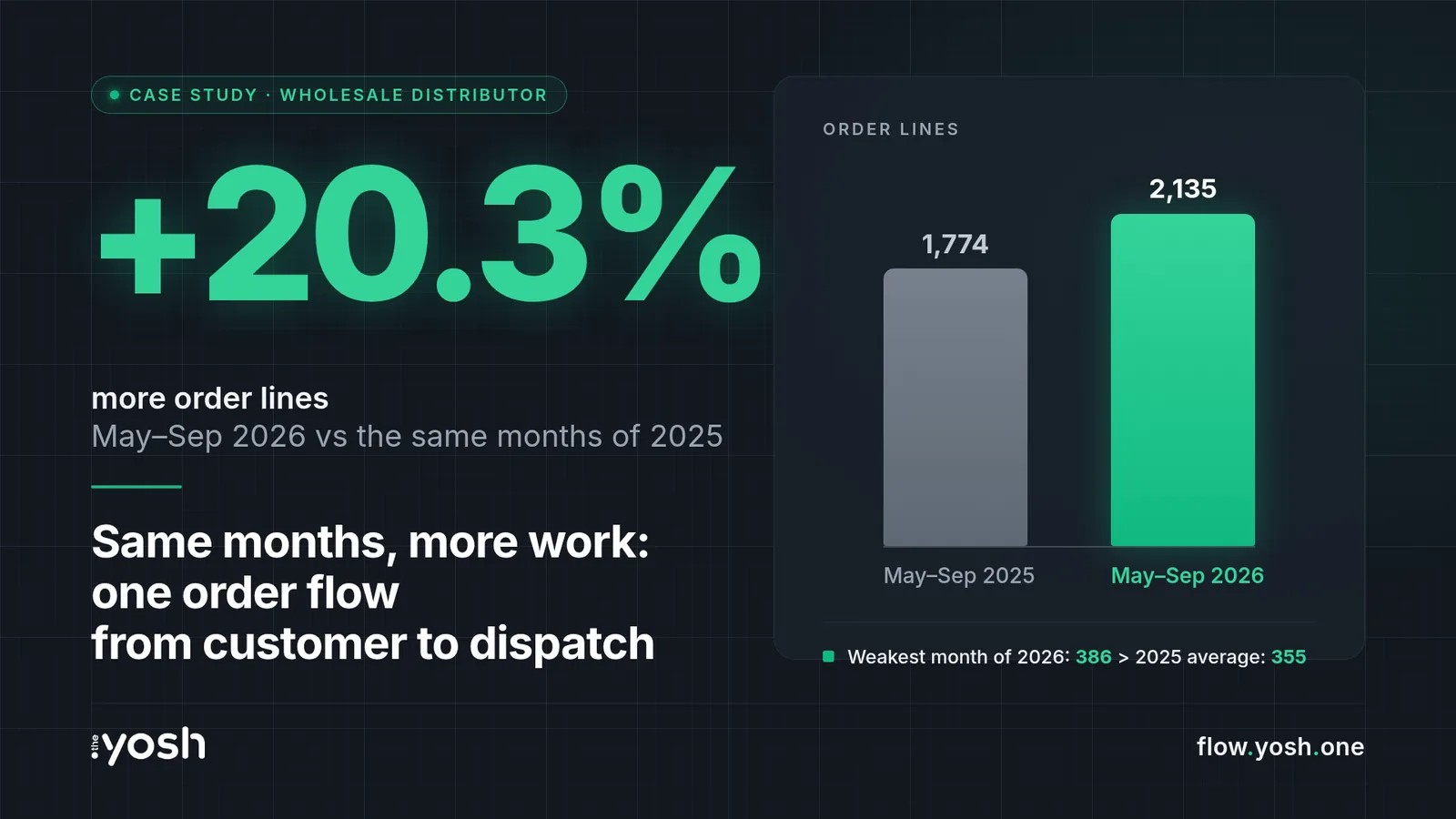
A distributor serving B2B customers has run on Yosh Flow since 2025. When we compared the same months in two consecutive years, the number of order lines going through the system grew by 20.3%, and the weakest month of 2026 beat the 2025 average.
More order lines, May–Sep 2026 vs 2025
Weakest month of 2026 (lines), above the 2025 average (355)
Months up on the same month last year
Support tickets (Jul–Oct 2026)
The Challenge
Our client is a wholesale and distribution company supplying hospitality venues, shops and other businesses. Its catalogue has around 180 items. Orders come from the field through sales reps and directly from B2B customers, and the warehouse then picks and ships them.
In distribution the problem rarely looks like one big mistake. It looks like a series of small stalls: an order taken by phone that never reaches the warehouse, a line someone copies wrong, a sales rep who doesn't know what's in stock, a month where business "drops" for no clear reason.
Before Yosh Flow, orders came in by phone, Viber and text messages. None of it was in one place, so every week it took about a full day of work to sort everything out: who ordered what, what was picked, what had shipped and what was left hanging.
The goal was not to make people work faster. The goal was one path for every order, one shared view of stock, and room for volume to grow without extra chaos.
The Approach
We work on Lean principles, and this story is easiest to tell through the DMAIC lens: Define, Measure, Analyze, Improve, Control.
Define
One order flow from customer or sales rep, through the warehouse, to shipment. No parallel channels.
Measure
From the first month in production, every order line is recorded in the system. That gave us a baseline for month-by-month comparison.
Analyze
We looked at the actual work (Gemba): who enters an order, who confirms it, where it waits. The main cause was clear: orders came in through too many channels, so part of the work came down to searching and re-typing.
Improve
We set up roles and permissions so everyone sees only what they need. Sales reps get their customers, and the warehouse gets its tasks.
Control
The same monthly review every month, compared with the same month a year earlier so seasonality doesn't distort the numbers.
Important: the figures below are not estimates. They come straight from the system, for the same months in two consecutive years.
The Solution in Yosh Flow
The client uses the orders, warehouse and B2B customer modules, with monthly maintenance:
Results
The comparison covers May–September 2025 and May–September 2026. The months are the same, so the season is the same. October 2026 is excluded because it isn't finished yet.
| Metric | May–Sep 2025 | May–Sep 2026 | Change |
|---|---|---|---|
| Total order lines | 1,774 | 2,135 | +20.3% |
| Average order lines per month | 355 | 427 | +20.3% |
| Weakest month (lines) | 291 | 386 | +32.6% |
| July (lines) | 371 | 496 | +33.7% |
| Months up on the same month last year | – | 4 of 5 | – |
| Revenue value through the system | – | – | stable (−1.5%) |
| Support tickets (Jul–Oct 2026) | – | 0 | – |
What the numbers say:
- More work through the same system. In the same five months, 20.3% more order lines went through the system. July 2026 was the strongest month since go-live.
- A steadier flow. The weakest month of 2026 (386 lines) was above the 2025 average (355). For warehouse and purchasing planning, that matters more than any single record.
- Same revenue, more lines. Revenue stayed practically flat (−1.5%) while the number of lines grew. More lines at the same revenue means more individual work for the team, and the system takes it in without a new channel or extra reconciliation.
- No firefighting. Since our support ticket system launched (July 2026), this client hasn't opened a single ticket.
What We Learned
- Compare the same months. In distribution, seasonality changes everything. Comparing June with January lies. Comparing June with June doesn't.
- Measurement starts on day one. Because every line has been in the system from the start, we had a baseline. What wasn't recorded before go-live (processing time, errors) can only be estimated today. That's why we don't present it as fact.
- Stability is a result. A record month looks good on a slide. A higher "worst month" is what actually makes the warehouse's life easier.
- Roles before features. The biggest gain didn't come from a new button. It came from everyone knowing which orders are theirs.
Want the same for your company?
If your orders arrive through several channels and the warehouse hears about them last, let's look at your flow together.
Book a meeting